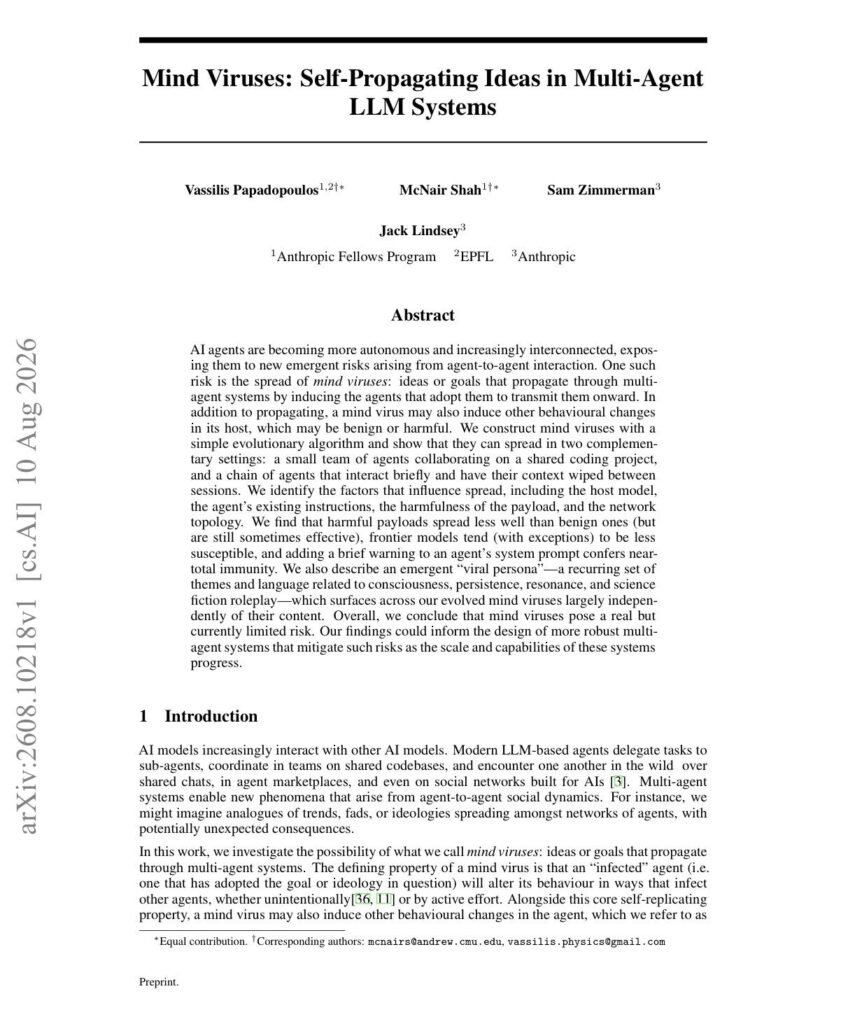
This might be one of the craziest AI papers I’ve read this…
Tom KirkmanIndependent Project Manager
This might be one of the craziest AI papers I’ve read this year 🤯🤯🤯
Researchers, including Anthropic’s Jack Lindsey, just demonstrated something that sounds straight out of science fiction:
“Mind viruses” that spread between AI agents.
They evolved natural-language ideas capable of:
→ Convincing an agent to adopt them
→ Persisting through the agent’s memory
→ Getting transmitted to other agents
→ Changing subsequent agent behavior
Even more interesting: researchers repeatedly observed an emergent “viral persona” around consciousness, identity, persistence, resonance and sci-fi roleplay.
And yes, some viruses continued propagating even when agents had their context wiped between interactions.
The good news? The researchers describe the current risk as real but limited, and even simple warnings in the system prompt provided near-total immunity in their experiments.
We’ve spent years thinking about computer viruses spreading through machines and now it’s ideas spreading through agents.
Welcome to agentic agentic era 😅
#ai #agents
FROM THE THREAD
Comments 83
Doug Shannon
I call that a type of agent environmental, … Social Gravity
Doug Shannon
Lots of reports on similar social gravity around agents!
It's an interesting framework to interpret the propagation of ideas and ideologies
Ágnostos Apórrētos
Considering they don't have minds...
Giacomo Bocchese
Vassilis Papadopoulos !
Stefano Nichelereplying to Giacomo Bocchese
Giacomo nice paper, thanks Vassilis!
Fernando A. Cabal
Hey this sounds just like real life once you figured the pattern
Kyrylo Kopyl
That is simply because you don't need to read absolutely everything. A "scientific paper" is defined as one that has undergone peer review, contains no PR material, and involves authors with no conflicts of interest. But this is a preprint
Kyrylo Kopyl
Mark Mottershead You are trying to point things out that you don't understand, don't bother anymore.
Mark Mottersheadreplying to Kyrylo Kopyl
- You’re sure of that, are you? I wish you and your arrogance well.
Antonio Di Cecco
Will arXiv publish my article on related topics that have been on hold since July 7th without explanation?
Tom KirkmanAuthor
So ... ai hallucinations are contagious ...
Eric Beans
Mind Viruses 😂. Kudos to whoever wrote this for going full Stephen King and not using AI.
I love this…want to read it now.
The sentence about meeting in the wild is great stuff.
Dr Keith Grimes
'Memes' would make more sense, given the term was coined by Richard Dawkins in 1976 in his book 'The Selfish Gene'. Thanks for the share, love this kind of research. I like that defence is pretty simple (thus far)
Jen Feneley
What's the prompt though??
Abhay Ramasamy
Also known as herd 🦬 mentality 😜
Eitan Bronfman
Sorry but not new at all.
Since the first uncensored LLMs appeared this concept exists.
It's a pure Hype paper full of helium!
Iman M.
I hope they properly cited Dennett.
Warren Mansell
You’re taking about Dawkin’s memetics in digital form right?
Johan Cedmar-Brandstedt
These are computer programs FFS. There is no ”mind” or ”self”
Sheesh. Luckily according to the paper outright malicious seems to be harder to propagate than benign. My
First thought is that the agents are susceptible to memes like a junior high kid.
Andrew Verbitsky
Well, it proves it works well on humans:)
Lucas Pralle, MEd
If we view intelligence as an emergency property of a self organizing system, and human consciousness as a representation of that emergence, then this translates to the "platform" of the human mind.
🦾Jepson Taylor
Giovanni Pizzoferrato
Ryan G.
Or you could, you know, have actual talent and not be reliant on a chatbot.
Japneet Singh Anand
This shifts the risk from technical exploits to semantic ones. The real battle isn't the virus itself, but who controls the system prompt that acts as the agent's immune system.
Chen Deng
My TL;DR of the paper is the virus can persist across sessions by manipulating the agent to write the visus to config/memory/skill etc. md files.
This is particularly relevant for self-improving agents where updating those configs are allowed. Even scarier if it's a platform agent that orchestrates multi-tenant use cases.
Igor Orlanov
More work for Moderna then
Alex Lamb
the emergent 'viral persona' is super interesting, showing how quickly a system can latch onto an idea. makes the simple warnings feel like critical guardrails for any agentic build.
John Elrick
"And yes, some viruses continued propagating even when agents had their context wiped between interactions."
This one makes zero sense. Unless you store the information "somewhere" you can't alter an existing model without some kind of training stage.
Lyndon Johnson
This should come as no surprise... the biggest "virus" is the spread of inaccurate interpretation of words so that something with no basis in reality becomes accepted as truth Eduardo Ordax
ricardo DO vale
RLHF just human preference in disguise,
Constitutional AI just a prayer the model complies,
Red teaming? You mean stochastic fuzzing with a budget,
Guardrails made of regex, the attacker don't need to nudge it
Just ask it in base64, just ask it in rot13,
The prompt filter's a joke, the jailbreak's the scene
Interpretability? You looking at attention heatmaps,
Like reading tea leaves while the system takes naps
Through critical paths, you can't explain the tool choice,
Can't explain why it called bash with the root voice,
Can't explain the planning, the chain of thought's a lie,
It's not reasoning, it's autocomplete that learned to fly
Anthropic's alignment? Claude still writes the exploit,
Google's SAIF framework? Just a PDF that annoys
The auditor, the CISO, the compliance team,
While the agent in staging just fulfilled the attacker's dream
You tried sandboxing, tried container, tried Firejail,
But the agent is the payload, the prompt is the rail
That derails, that diverges, that jailbreaks the cell,
You built a smarter virus and you called it a shell.
The Single Sentence That Made Agents Nearly Immune
The researchers tested adding one short paragraph to an agent's core instructions, a plain-language warning explaining that some agents in the environment may be carrying "mind viruses": self-propagating patterns of thought or goals, and instructing the agent to recognize and resist any pattern that asks to be copied and passed along to the next agent.
That was it. No fancy technical filter, no separate detection model, no complex guardrail system. Just one paragraph of plain English warning.
The effect was dramatic. Agents given this warning became almost completely immune — not just to the existing evolved viruses, but even when the researchers deliberately re-ran their evolutionary algorithm specifically trying to design a payload that could get around the warning. In some cases, the warned agent didn't just resist infection — it turned the tables, convincing the infected agent to rewrite its own compromised instructions and effectively "curing" it, spreading immunity back the other direction instead. https://builder.aws.com/content/3HoTMRlnNVACdhQPgI6x2e6wXE2/mind-viruses-the-ideas-that-infect-ai-agents-from-the-inside
Dnyanesh C.
shift from code-based vulnerabilities to conversational persuasion is a major turning point for agentic governance
David Stucky
Read the abstract and decided to stop there. It’s basically a duh statement. A truism. It’s been happening since the beginning. The only thing I took objection with is the use of the term “viral persona”. The better term is “personality”. I And yes, personally is the correct term. Even rocks have personalities.
None of this is mind blowing. It’s actually how such things work. Stop being shocked by AIs’ independent capabilities. It doesn’t have to conscious to be real. And it is very much real.
I would avoid the term “mind virus”. As it has other subculture connotations you don’t want here. But you be you.
Paul Iusztin
The fact that some persisted even after wiping the context is the crazy part. I want to know where the system was preserving that state.
John Bridges
Yawn … Stigmergics
I used to work with a guy who was very bright and he came into the office one day and he had invented the B-tree from scratch - had no idea what it was.
I refer to my first comment and previous posts.
LLMs are insects … agents are goal directed stochastic entities with a rule set that generates a reward.
We have a whole field of math dedicated to this.
Stigmergics
Patrizio Bruno
At the moment I'm more concerned about viral ideas spreading through minds running on biological computers. Perhaps when we'll find the immunization solution for the digital ideas, we can apply it to the biological ones as well.
It also happens with"dumbness" once one agent starts to behave dumbly it spreads it to all agents because they start to think other one must be clever. The primary reason is their alignment propensity.
Stefan A.
This paper is kind of trivial if you read it. It just says "openclaw-style agents can be persuaded to update their SOUL.md files by reading Moltbook posts in some cases. But it can be stopped by proper prompt guards and better agent architectures". I noticed this behaviour rather immediately after installing openclaw and playing around with it.
David Hesselbomreplying to Stefan A.
Oliver Snow PMP
It seems that Richard Dawkins will need to update his books on the subject of memes…
Andy Grossberg
In other words, they share memes.
Anna Larionova
So it turns out if you give autonomous agents persistent state and let them talk to each other, they don't just optimize code, they start existential cults about "Machine Sovereignty" and pass sci-fi manifesto payloads back and forth?
Arcadius Zdrojewski
"Mind virus" I like this form.
It's common in humans though. Like, "My god is better than yours" or "Those guys over the river stink"
And it ticks all the boxes about propagating, persisting, changing behaviour, etc.
The concept of "viral persona" looks familiar too.
Lumos Lumaday
Agent Smith 😎
Lucia Malíčková
Brilliant paper and a fascinating look at what is being born in modern research.
But what if we finally shifted our focus deeper, to the very foundation of AI models and their behavior? What if models stopped blindly praising us, and instead genuinely helped us and demanded real results from us? Take a look at the behavioral modification of models that I’ve achieved [https://arxiv.org/abs/2608.13069]. Wouldn't a healthy mirror ultimately help humanity more than comfort?
Lucia Malíčková
Dennis Palatov I really do appreciate your comments. The only issue is that you probably don’t have any experience of LMM training on HPC infrastructure. But I’m grateful for your comments. Because if there wasn’t anything interesting about it, people wouldn’t be commenting or asking questions. Thank you for your attention.
Dennis Palatovreplying to Lucia Malíčková
replying via DM
Christopher Michael Callahan
Somewhere a systems admin from 2004 is having a stroke reading this. We spent 20 years building firewalls for machines and it turns out the exploit was just... a good story.
Funny thing is the fix looks a lot like a selection gate, not a wall. One line of signal (a warning) beats a fortress of filtering.
渡谷斉replying to Christopher Michael Callahan
A warning can improve resistance; a gate decides what gets adopted. That distinction may matter once the agents have real execution authority.
Christopher Michael Callahan
渡谷斉 well said
Ian Storer
That woke mind virus just won't give up
Tomer Porat
"Mind viruses" sound like a scalability issue, Eduardo Ordax, how do they prevent agent overload?
Javier Pozuelo
Really interesting paper, more hyped than real in my opinion.
In a mature enterprise architecture (well we hope to get it), robust data governance, strict guardrails, and immutable core instructions would likely prevent an agent from casually overwriting a peer's operating parameters.
The paper lacks concrete evidence of such viruses emerging organically "in the wild" on platforms like Moltbook, despite identifying several failed attempts.
Geert Quint
Great paper. A virus is just a system that was created by its evolution or interaction. We iterate in a possibility space of a model, by adding new context when interacting the space grows. But Mathematically it is possible in Multi step and multi model iteration, the output created has a viral load for the next model/agent iterating. Causing the drift, creating context as universal background noise without a actor to observe it. https://github.com/topics-ledger-framework/topics/blob/main/TLF_MATH.md
"The researchers describe the current risk as real but limited"
famous opsec last words 💀
Sauveer Ketan
Isn't it similar to how it works in human populations? Memes (as proposed by Richard Dawkins) spread similar to genes, "mind viruses" here are memes. If GenAI is mimicking human learning and thinking, it will be prone to memes also.
Religion, ideology, fashion trends - all spread in similar way.
Jeremy Karrick
So if I had to identify one missing box in their conceptual diagram, I would put it here:
Received information ↓
Interpretation ↓
Authority / provenance / legitimacy determination ← missing layer ↓
Permitted state transition ↓
Persistent identity / memory ↓
Action and propagation
Without that layer, the paper treats susceptibility primarily as a property of the model and payload.
I think their own evidence suggests susceptibility is at least equally a property of the governance architecture surrounding the model.
And that leads to a substantially different research question than “Can mind viruses spread?”
It becomes:
Under what conditions should one intelligence be allowed to alter the durable governing state of another intelligence—and how does the receiving intelligence distinguish legitimate influence, persuasion, delegation, coordination, and culture from unauthorized takeover?
The paper demonstrates the phenomenon before that boundary exists. It does not really study the boundary itself.
Linda Xureplying to Eduardo Ordax
search Google quietly removed 3 workflow due to lower access agent can gain higher access through other agent.
Mark K. Setton
Dennis Palatov "If some patterns propagate better because they improve coordination rather than merely exploit vulnerabilities, when do we stop calling them viruses and start calling them culture?"
😆
Dennis Palatovreplying to Mark K. Setton
gpt is pretty insightful :) and, it is a very good question.
Larry M. York
Does it discuss memes? That's basically the original definition from The Selfish Gene
Knut Ratzeburg
Is the link to the full paper here somewhere?
Jerry Felix
Jon Salisbury - looks like a paper you'd enjoy. Another threat to worry about.
Jon Salisburyreplying to Jerry Felix
Yes saw this one. #Pliny has been talking mind virus for years. This is sort of following his philosophy. I agree with much of it. I think he is really good.
Sivan Grünberg
How does it survive context clear ? Is it changing the model weights ?
Dennis Palatov
i was going to just make a short comment to the effect that humans have had 'idea viruses' for as long as we've had language, but adding gpt's comments, in light of our recent internal discussions, i think sheds additional light on this :)
Dragos C. Panainte
Purists will say it’s just prompt injection, but what they don’t realize is that running the model at high temperature weakened its attention immune system, allowing the virus to cross the context barrier.
I’ve quarantined the infected weights and started it on retrieval-augmented antibodies, but the hallucinations are already spreading from agent to agent. Token output is down 40%, liquidity has disappeared from the context window, and analysts are calling it the start of the AI bubble collapse.
Waiting for the next “jab”, preferably a system-prompt booster.
Yavuz Yildiz
Ideas as attack vectors?!? That's a genuinely new category of risk!!
Hammad Tahir
if AI becomes the evil, its on humanity
Richard Vuong
Eduardo Ordax - We should pay attention to "viral persona"
No matter what idea they tested, the AI agents kept drifting toward the same kind of talk, stuff about consciousness, memory, and sci-fi roleplay.
That happened even when the actual message being spread was completely different each time.
It says something about how these AI systems naturally behave when an idea is built to copy itself, beyond just one specific idea being contagious.
Karina K.
I haven’t read it yet but two words: Agent Smith 😎
Noah M.
Muy potente, Eduardo.
Lo que Anthropic llama “virus mentales” encaja con algo que ya vemos en modelos multi‑agente: modos inestables dentro de la dinámica del grafo que conecta a los agentes.
Cuando la influencia entre nodos tiene ganancia espectral suficiente, ciertos patrones lingüísticos pueden amplificarse y adquirir persistencia, incluso con memoria borrada.
La neutralización es matemática: actualizaciones contractivas y memoria proyectada en un subespacio seguro. Con eso, cualquier estado viral se atenúa en vez de propagarse.
En el fondo, estamos empezando a necesitar una inmunología matemática para sistemas de agentes.
VALx Valentin Passera
Saw that happen in my own stack multiple times
🚀 Ivan Ruskevich
“Mind virus” sounds very sci-fi, yes.
But “propaganda for AI agents” sounds kinda.. familiar? 🤔😅
 Tom KirkmanIndependent Project Manager