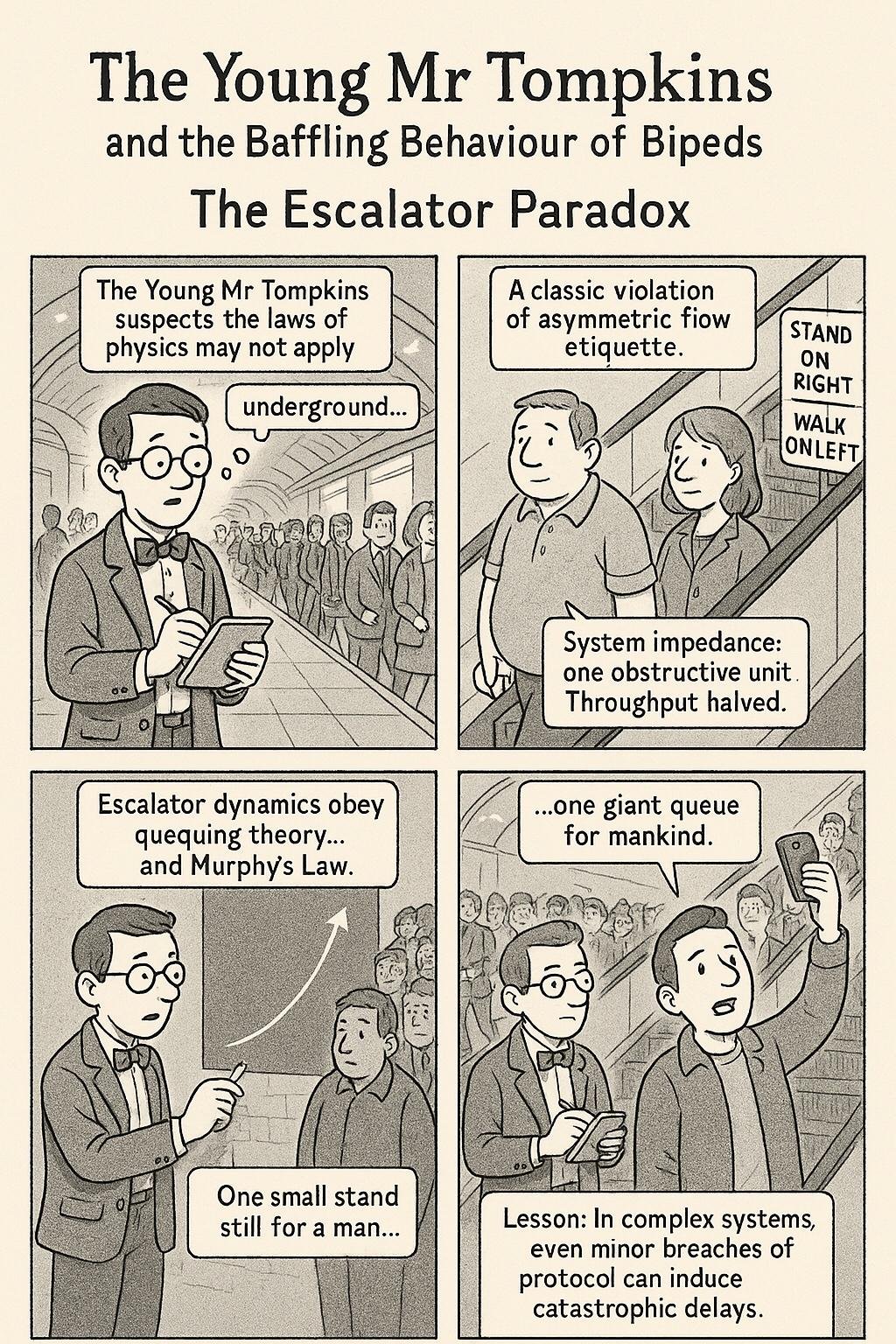
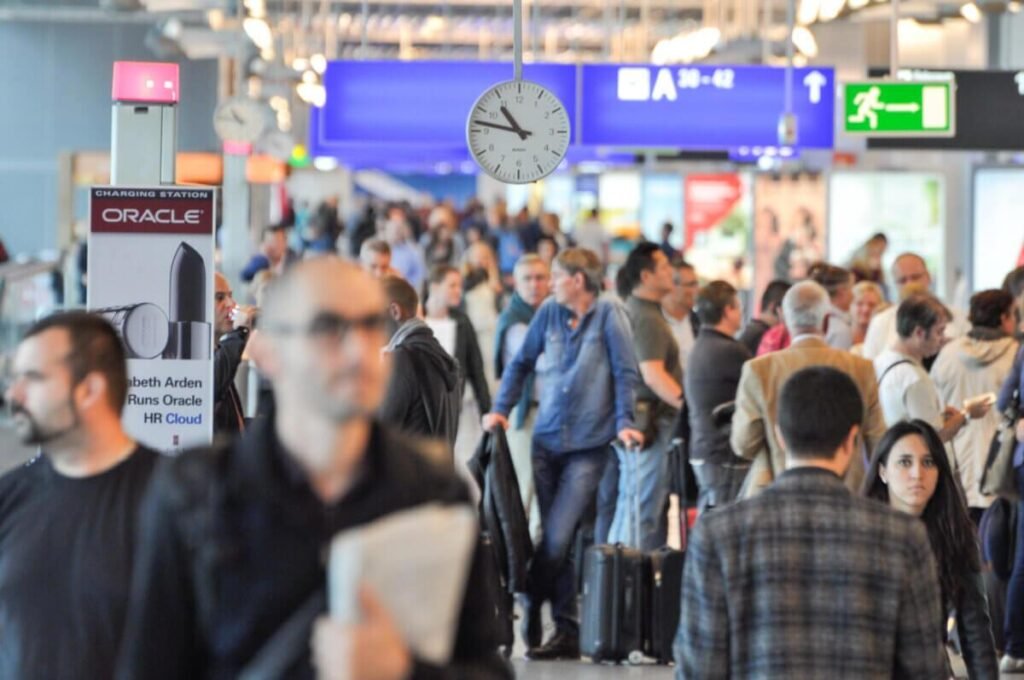
Crowd lanes echo project management guard rails
 Tom KirkmanIndependent Project Manager
This reminds me of the “Guard Rails” concept in Project Management.
Keeping many different streams of actions by a wide assortment of stakeholders (people) in an organized forward motion, and stepping in as a Project Manager to help “unstick” bottlenecks and deviations from the planned forward motions.
My own invented term for this de-bottlenecking is “Reducing Randomity”.
Putting some controlled order into excess chaos.
================================
“In a nutshell:
⚫ Crowds naturally form organized lanes when most people walk in two main directions, but become chaotic when walking directions vary beyond a critical threshold of 13-16 degrees.
⚫ Walking speeds in disordered crowds are approximately 30% slower than in organized ones, showing how crowd order directly impacts pedestrian efficiency.
⚫ Wider pedestrian crossings might actually reduce flow efficiency by allowing greater directional variation that disrupts the natural lane formation process.
Walk through a busy train station during rush hour and you’ll notice something fascinating: people often form natural lanes, creating orderly streams moving in opposite directions.
Yet step onto a crowded plaza with folks heading in multiple directions, and that organization vanishes into chaotic movement.
This shift between order and chaos is no accident – it follows precise mathematical rules that scientists have now uncovered.
Recently published research in the ‘Proceedings of the National Academy of Sciences’ reveals the mechanics behind how crowds transition between organized and disorganized states.
A team from MIT, Poland’s Academy of Physical Education in Katowice, and the UK’s University of Bath found that this switch happens at a specific mathematical threshold.
The study examines what scientists call “motile active matter”—systems of independently moving entities.
Unlike schools of fish or bacterial colonies that typically move as unified groups, humans in public spaces each have their own destination and path.
This creates a perfect real-world laboratory for studying complex collective behaviors.
Researchers look at the “angular spread parameter” within crowds – essentially how varied people’s walking directions are.
When pedestrians mostly walk in two opposite directions (think people crossing a street), they naturally form lanes.
⚫ But introduce too many different walking angles into the mix, and order collapses into chaos.
Most surprisingly, this transition happens at a specific mathematical point.
⚫ When the standard deviation of walking directions exceeds roughly 13-16 degrees, the crowd shifts from organized lanes to disorganized movement.
This finding was consistent across mathematical theory, computer simulations, and experiments with real people. …”