Removing electrons from diamond creates a new time crystal
 Tom KirkmanIndependent Project Manager
Apparently, removing some electrons from a diamond causes some interesting effects.
=================================
“Physicists have created a new type of time crystal that may help confirm some fundamental theories about quantum interactions.
A standard time crystal is a new phase of matter that features perpetual motion without expending energy.
According to Chong Zu, an assistant professor of physics at Washington University in St. Louis and one of the team’s lead researchers, a time crystal resembles a traditional crystal.
However, unlike a traditional crystal, which repeats a pattern across the physical dimension of space, a time crystal repeats a pattern of motion, rearranging its atoms in the same way over time, Zu said.
This causes the time crystal to vibrate at a set frequency.
A time crystal is theoretically capable of cycling through the same pattern infinitely without requiring any additional power — like a watch that never needs to be wound.
The reality, however, is that time crystals are incredibly fragile and thus succumb to environmental pressures fairly easily.
Although time crystals have been around since 2016, a team has achieved something unprecedented: They’ve created a novel type of time crystal called a time quasicrystal.
A quasicrystal is a solid that, like a regular crystal, has atoms arranged in a specific, nonrandom way, but without a repeating pattern.
This means that, unlike a standard time crystal that repeats the same pattern over and over, a time quasicrystal never repeats the way it arranges its atoms.
Because there’s no repetition, the crystal vibrates at different frequencies.
As the researchers state in their findings, published in the journal Physical Review X, time quasicrystals “are ordered but apparently not periodic.”
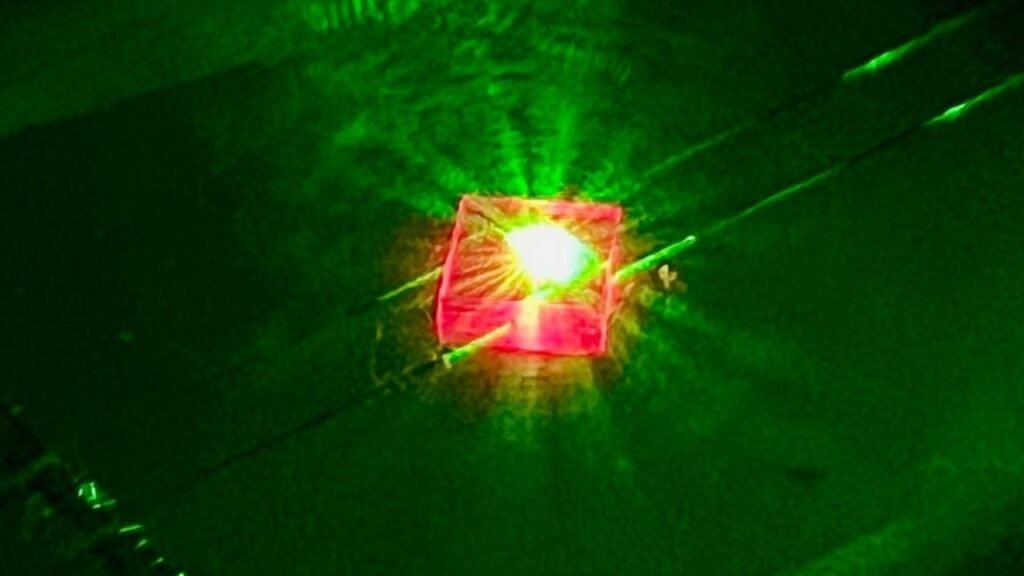
To create these new time quasicrystals, the researchers started with a millimeter-sized piece of diamond.
Then, they created spaces inside the diamond’s structure by bombarding it with powerful beams of nitrogen.
The nitrogen displaced carbon atoms within the diamond’s interior, leaving behind empty atomic chambers.
Nature abhors a vacuum, so electrons quickly flowed into these empty spaces and immediately began to interact with neighboring particles on a quantum level.
Each time quasicrystal represents a network of more than a million of these empty spaces inside the diamond, though each measures just one micrometer (one-millionth of a meter). …”