More on 3D time and six dimensions
More about 3D time / 6 Dimensions of time + space.

My post last week about 3D time is here:

“Can both time and space each have 3 dimensions?”
Open link ↗

This article below explains the concept of 3D time a bit better.

========================================

“3D Time Could Solve Physics’ Biggest Problem

Clocks might be far more fundamental to physics than we ever realized.

A new theory suggests what we see around us
– from the smallest of quantum actions to the cosmic crawl of entire galaxies – could all be literally a matter of time.

Three dimensions of time, in fact.

The basic idea of 3D time isn’t new. But University of Alaska geophysicist Gunther Kletetschka says his mathematical framework is the first to reproduce known properties of the Universe, making it a somewhat serious contender for uniting physics under one consistent model.

“Earlier 3D time proposals were primarily mathematical constructs without these concrete experimental connections,” says Kletetschka.

“My work transforms the concept from an interesting mathematical possibility into a physically testable theory with multiple independent verification channels.”

Something is wrong with our current models of reality.

While quantum mechanics and general relativity both explain our Universe to a degree that’s uncannily accurate, each emerges from fundamentally distinct grounds – one granular and random, the other seamless and immutable.

[ … ]

1) > On the cosmic end, time can be relative, distorting in relation to mass and acceleration.

2) > Up close, time is undecided, equally capable of looking to the past as it does to the future.

3) > And drifting in the middle is an existence as boringly predictable as tomorrow’s sunrise.

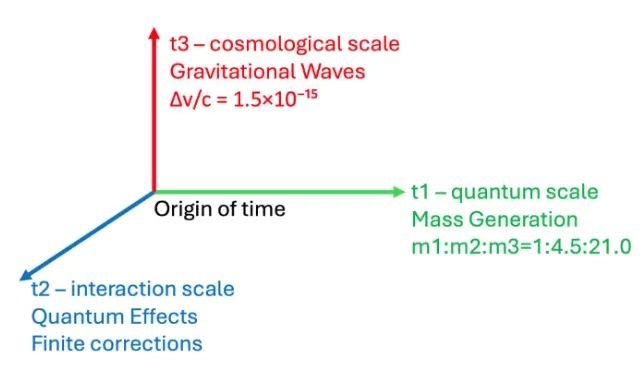
Separating these scales into their own dimensions provides us with three paths to follow, each marching to its own beat at right angles to the others.

< see embedded graphic below for this post >
< Time flows in three dimensions in a new framework of physics >

By embedding these timelines in mathematics that preserves cause and effect, it’s possible to link all three dimensions in a way that could explain everything from :
—> how fundamental particles pop up in quantum fields,
—> to why we can’t experience quantum weirdness,
—> to the expanding boundaries of the Universe itself.

“These three time dimensions are the primary fabric of everything, like the canvas of a painting,” says Kletetschka.

“Space still exists with its three dimensions, but it’s more like the paint on the canvas rather than the canvas itself. …”

Open link ↗
.

FROM THE THREAD

Comments 18

  1. Thomas Troszak

    Tom Kirkman I remember one of those on-campus crusades urging the passers-by to sign a petition - and join in the fight to adopt "Metric Time"😃 - they even bearded some governmental-official type on the monumental stairs of some great institution - to which petition he replied "Yes, yes - our people are already looking into that"🧐

  2. Thomas Troszak

    Andrew Aligizakis " day and night do not actually exist: the earth turns." True. But at the North Pole, actual "days" and "nights" do exist, and last about 6 months each. But then again, the folks orbiting Earth in the ISS are 'turning' too, and they see about 16 sunrises, 16 "days", 16 sunsets, and 16 "nights" per "Earth Day"... so, um... yeah... er, maybe...🤔

  3. Thomas Troszak

    Andrew Aligizakis "Give me a millihour to think about metric time." Take as many as you like, sir. And always remember "The oxen are slow, but the Earth is patient."😃

  4. Simon Derricutt

    Odd thing is that never turned up in my feed.

    I suspect any attempt to treat time as a real dimension in which you can go both forwards and backwards will lead to non-physical conclusions. Point is that if anything at any time went backwards in time, then the whole universe would need to be totally predetermined from Big Bang to Big Crunch or whatever happens at the end of time. It's a fairly obvious logical conclusion, and the result is that going backwards in time is something that is actually impossible.

    The appearance of things going backwards in time is however possible, depending on relative velocities of observer and observed. Problem if you think that what you see happening is in fact what is happening, given that there is always a delay between when something happens and when information about what has happened reaches the observer. Yep, that delay cannot be negative....

    Theories involving reverse time may give good predictions a lot of the time. May be useful in practice. Just bear in mind that it's not reality and may be badly wrong in some predictions.

  5. Simon Derricutt

    Aaron - back to the earlier assertion that a surprisingly wide range of incompatible theories can be pretty good at predicting what we measure to happen. The corollary here is that the ability to predict what happens doesn't imply that the theory/idea is actually correct, just that it can be useful in predicting what will happen over the range of conditions it's been tested for.

    If you like the idea, and it fits your way of working so it's easy to implement, go for it. Just don't fall into the trap that since it's giving the right answers it must be the right explanation for what's really happening here. You may at some point come across something happening that you thought was impossible, or find it impossible to do something you thought could be done.

    Maybe not the most pleasant way to live, always wondering if the foundations are sound or not and whether you need to drop something you've believed was true all your life, just might be necessary.

Leave a comment

Your email address will not be published. Comments are checked before they appear.

Keep reading

Enjoyed that?
Get the next one.

New posts on energy, projects and Weekend Science — straight to your inbox, without the algorithm.